Omoksee: Pattern Racing With Native Roots
Omoksee — written O-Mok-See — is timed pattern racing: riders run standardised speed patterns such as poles, barrels, and keyhole against the clock, in a family sport whose name and origins trace to the Blackfeet people and whose national championships are a Montana tradition.
A Name From the Blackfeet
The sport's own tradition traces its name to a Blackfeet phrase commonly rendered as a gathering of riders — a big dance of horses — and its patterns to the games mounted Native riders ran long before they were written down as rules. In the twentieth century those games were organised into a formal sport with standard patterns, age divisions, and a national association, and its championship gathering settled in Montana, where the National O-Mok-See has been a fixture of the summer calendar for generations of Western families. The spelling varies — Omoksee, O-Mok-See — but the sport is one: patterns, ridden fast, against the clock.
Patterns, Not Just Speed
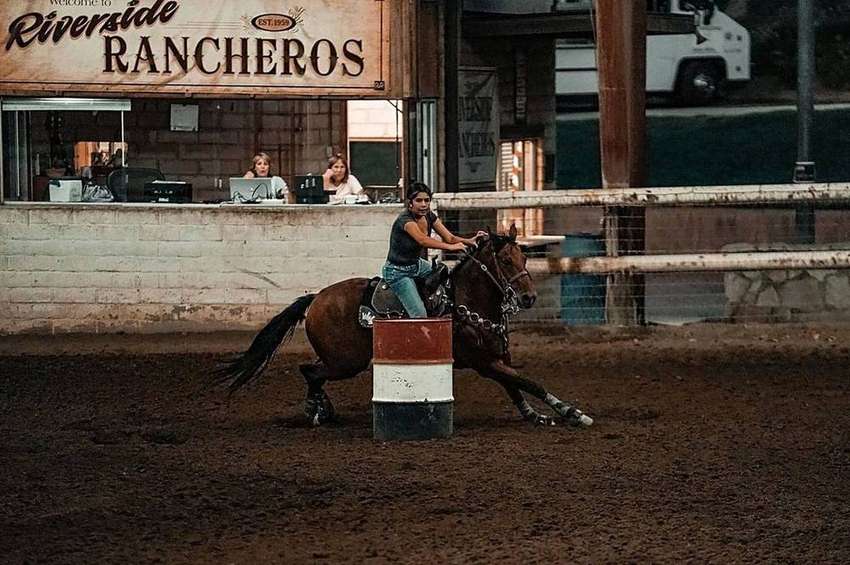
What separates omoksee from ordinary gymkhana is standardisation. Events such as pole bending, barrel racing, the key race, flag racing, and a catalogue of named patterns — figure eights, stake races, and more — are run to defined layouts, so a time set in one arena means the same thing in another, and records can stand across years. This library's gymkhana page covers the broader family of speed games; omoksee is its most rule-bound branch, where the pattern book is the sport's constitution and a knocked pole or a broken pattern costs the run no matter how fast the horse.
A Sport Built for Families
Omoksee organises its riders by age, from small children on steady horses to adults, and its culture is famously familial: grandparents who ran patterns hand the sport to grandchildren, and a weekend meet mixes fierce timing with a church-picnic atmosphere. The horses are all-rounders rather than specialists — a good omoksee horse is handy, honest, and quick from a standstill, turns tight without losing its feet, and rates back the instant the pattern ends. Riders learn the horsemanship of economy: the shortest line, the cleanest turn, and no wasted motion anywhere on the course.
Precision at Speed Is the Whole Lesson
Newcomers are often surprised that omoksee champions talk about accuracy before speed. The arithmetic is unforgiving — penalties and disqualifications erase fast times, and patterns reward the rider who adds speed only as fast as control allows. That makes the sport an unusually good school: young riders learn that a horse is not a motorcycle, that turns are made with seat and eye before hands, and that the clock rewards partnership over force. It is, in the end, the same lesson its originators built into it — the gathering is the point, and the race is how the gathering honours the horse.
Keep reading
From the ranch